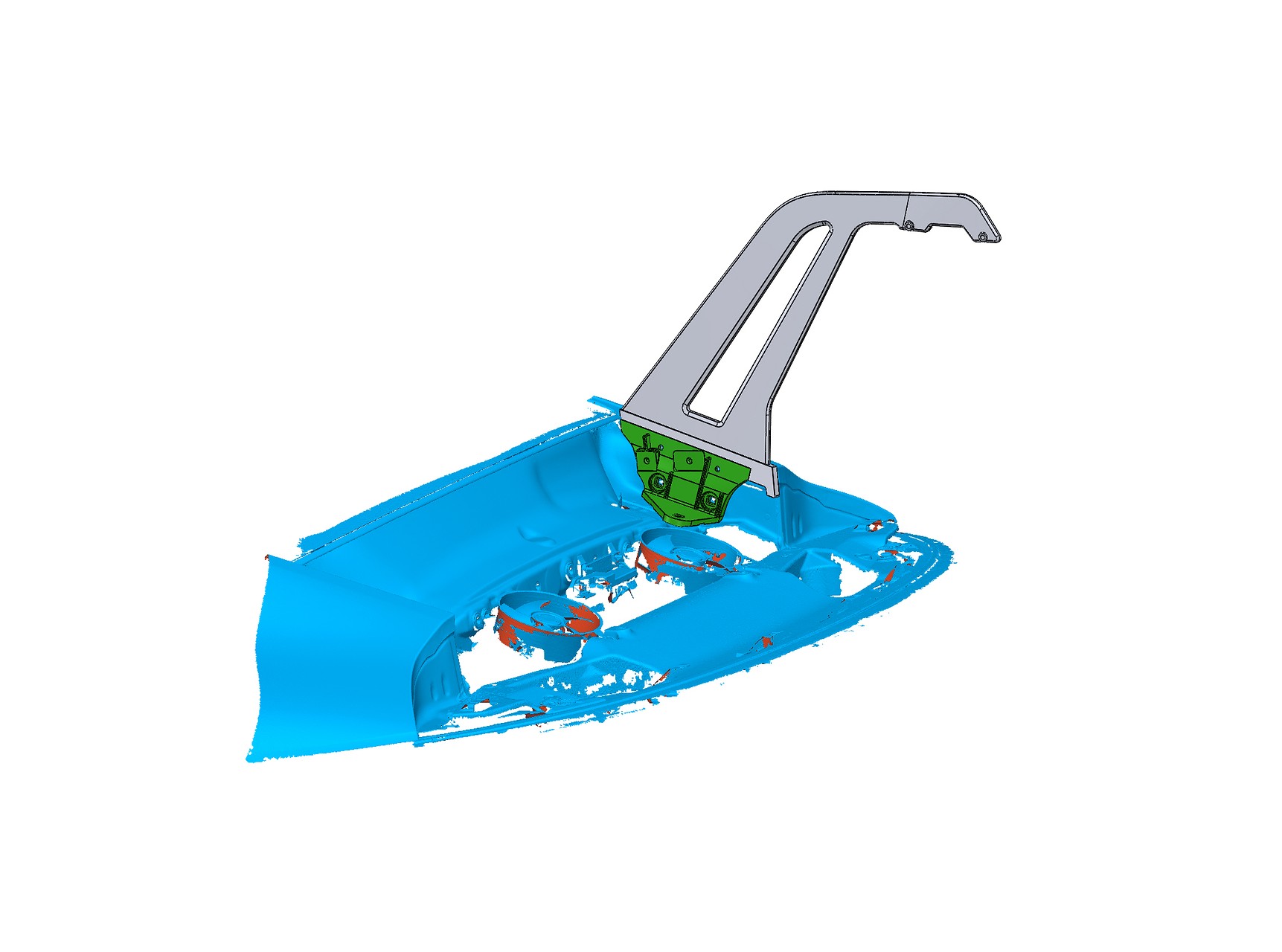
Reverse Engineering Services in New York City
Transforming physical parts into production-ready digital models for manufacturing, restoration, and custom fabrication
At Kemperle Industries, we convert physical parts into accurate, editable CAD models or manufacturing, including OEM replacement parts and custom components. Using high fidelity 3D scanning and engineering-driven CAD reconstruction, we recreate, repair, and prepare components for 3D printing, CNC machining, and other fabrication workflows, especially when original drawings or files no longer exist.
Learn more about our 3D Scanning Services
Learn more about our 3D Printing Services
Learn more about CNC Machining
What Is Reverse Engineering?
Reverse engineering bridges the gap between physical objects and digital manufacturing. While 3D scanning captures geometry, reverse engineering transforms that data into parametric, manufacturable CAD models that can be edited, improved, and reproduced.
It is essential when:
-
Original design files are missing or outdated
-
Parts are worn, damaged, or discontinued
-
Components must fit existing assemblies
-
Geometry must be modified for new materials or processes
-
Production or repeatability is required
Our reverse engineering services are commonly used for:
-
Replacement parts with no CAD files
-
Legacy or discontinued components
-
Damaged or worn parts that need correction
-
Custom or one-off components
-
Design updates for additive or subtractive manufacturing
-
Tooling, fixtures, and jigs
-
Automotive and marine restoration
-
Industrial equipment repair
-
Art, sculpture, and cultural heritage reproduction
Our Reverse Engineering Workflow
We begin by capturing the part using structured light or laser scanning, depending on size, complexity, and required tolerances. Multiple scans may be combined to ensure complete coverage of complex geometry.
The goal is not just to capture shape, but to produce trustworthy data for engineering decisions.
Learn more about our 3D Scanning Services
Raw scan data is refined to remove noise, correct surface artifacts, and ensure watertight geometry. At this stage, we validate the scan against the physical part to confirm dimensional accuracy.
This step determines whether the mesh can be used directly or requires full CAD reconstruction.
For functional or production parts, we convert scan data into parametric CAD models using surface reconstruction and solid modeling techniques.
This enables:
-
Precise tolerances
-
Editable dimensions
-
Feature recognition
-
Long-term reuse of the model
-
Manufacturing-ready geometry
Once CAD is established, we optimize the model for its intended manufacturing method—whether additive, subtractive, or hybrid.
This includes:
-
Tolerance adjustments
-
Wall thickness correction
-
Material substitution
-
Stress relief and fillets
-
Orientation planning
-
Process-specific modifications
Explore our 3D Printing Services
Reverse engineering is most powerful when it produces manufacturing-ready CAD models, not just digital replicas. At Kemperle Industries, we reverse engineer parts specifically for additive and subtractive manufacturing workflows, ensuring that reconstructed geometry can be produced reliably and repeatedly.
Once a part has been captured and reconstructed in CAD, we evaluate the most appropriate manufacturing method—3D printing, CNC machining, molding, or hybrid workflows—based on performance requirements, tolerances, material behavior, and production volume.
Supporting Additive Manufacturing
For additive workflows, reverse engineering enables:
-
Accurate wall thickness and reinforcement
-
Proper orientation and support strategy
-
Material-specific geometry optimization
-
Stronger, more reliable printed parts
-
Repeatable production of functional components
This approach is critical for end-use parts, tooling, fixtures, and low-volume production, where raw scan data alone is not sufficient for consistent results.
Supporting Subtractive Manufacturing
For CNC machining and traditional fabrication, reverse engineering allows:
-
Precise tolerances and datum alignment
-
Feature reconstruction for machining
-
Surface continuity for toolpath generation
-
Reliable reproduction of legacy parts
-
Preparation for mold or tooling creation
This is especially valuable for replacement parts, industrial equipment, and restoration projects where accuracy and fit are non-negotiable.
Hybrid Manufacturing Workflows
Many projects benefit from combining both approaches. It is common for parts to be:
-
Scanned and reconstructed in CAD
-
3D printed for validation or testing
-
Machined for final tolerances
-
Finished or assembled for production use
By designing reverse engineered models with both additive and subtractive processes in mind, we reduce risk, improve accuracy, and accelerate time to production.
Choosing the Right Manufacturing Path
The goal of reverse engineering is not to force a part into a specific process—it is to create a flexible, accurate digital model that supports the most effective manufacturing method for the application.
We evaluate:
-
Load and performance requirements
-
Environmental exposure
-
Tolerance and fit
-
Material availability
-
Production volume and cost
This ensures every reverse engineered part is optimized for how it will actually be made and used.
Kemperle Industries supports reverse engineering projects across multiple sectors:
-
Maritime Customization
-
Product Design & Engineering
-
VFX & Entertainment
Each industry presents unique challenges, which we address through engineering judgment and collaborative process selection.
Frequently Asked Questions
Can you reverse engineer a part without drawings or CAD files?
Yes. Reverse engineering is specifically designed for situations where original documentation does not exist.
Can you reverse engineer OEM parts?
Yes. We reverse engineer OEM parts for repair, replacement, and internal use, particularly when original files or suppliers are no longer available. Clients are responsible for IP considerations.
How accurate is reverse engineering?
Accuracy depends on scanning method and part size, but sub-millimeter accuracy is achievable in many cases.